Showing posts with label Women's Rights. Show all posts

Friday, January 25, 2013

A Night with Women from the Greek Orthodox Church


An  experienced that happened in early November of 2012 in Amman, Jordan:  

               The Christian world in the Middle East has continued to be a foreign subject to me regarding my studies and exposure. After last week’s experience with the Coptic Church, I was able to see a church setting much differently than my own and come to the conclusion that there were some similarities between the Islam and Christianity in how sacred some things are. People’s mentality towards things can be similar but in the Middle East it seems that strong practicing Muslim and Christian women’s mentalities are very different.

                Turns out a group of BYU students have been going to the Greek Orthodox, Church of Our Lady, on a weekly basis to their week night Sunday school type of class, maybe more equivalent to an LDS institute class. They would go to practice their Arabic and learn more about the Christian culture. This particular night no one could go but one of the BYU girls. She couldn’t go alone so she invited me to head on out. It also was supposed to be their Halloween party. We show up to the church and quickly notice it is not a Halloween party (lucky I just used my scarf from Scotland as my costume) and rather a normal class similar to the class I went to at the Coptic church but there seemed to be many more people and the father was speaking into a microphone so that everyone could hear him. My friend Sally and I sat near the back after she looked for her friends but to no avail, she couldn’t find them.
               
                The sermon was about a huge array of topics. Some of the topics included doing good unto others and following the example of Christ. You could tell that everyone appreciated the Father very much because each time someone spoke with a comment or a question they would express gratitude for the Father. The chairs that Sally and I sat in were almost like thrones, a large wooden chair with arm rests. Turns out instead of pews, each chair was like this with not too much room between you and the chair in front of you. When the sermon was done, Lucy’s two women friends found her and began talking to her. Lucy introduced me to them and they seemed to cling to me as close as they could without touching me. While sitting in my throne like chair, they stood right in front of me so I couldn’t stand up or leave if I wanted to. In the Middle East, I have learned to keep a large bubble around me when it came to women, I would not allow them to get near me and me near them. This bubble that I have spent two months building was popped and I couldn’t do anything about it. I almost felt physically violated because their legs were right next to mine and I couldn’t do anything about it. They continued to stand in front of me as they talked to others around them. And to my dismay, the Father showed up and wanted to greet me. I wanted to meet him and speak with him but not in this setting. So I lifted my hand up over the person sitting next to me and we shook hands from a far distance. I was surprised he didn’t mention anything to the women and their distance next to my legs. I finally had to ask them to move so I could get up.
               
                These two women then wanted to invite Lucy and I out to coffee and tea at a restaurant type of setting. Lucy and I agreed but it seemed to take about 40 minutes to finally leave the church because the two women, including my friend Lucy were busy talking to people of both gender, hugging and farewell kissing non-stop. Lucy and I rode with one of the girls to this more modern café house. The two women were more free in there dress, shoulders were showing, lower cut shirts and they let their hair hang loose. This is again the opposite of the conservative Muslims that I have met, they reminded me a lot of normal American women with their appearance. I do not feel that these women were the type that you would consider “loose” but were at more liberty to dress the way they wanted and to speak with who they wanted. During our discussion at the café while they drank their coffee and Lucy and I our shakes, they both vocally mentioned they wanted to marry American men. I wasn’t sure that was a hint or not to me but it sure they liked how American men are more forward in wanting to date and having a relationship than Arab men are. They were fairly attractive women in their mid-30’s and seemed to love to gossip. Shortly after getting our drinks, another group of Lucy’s friends showed up and these two women kept to themselves. I was able to hear their speaking topics which were about the other girl’s clothes, how she was still single, and how she wore glasses. Honestly, I think they were jealousy of her because the other girl that just joined us, though maybe not as pretty as the other two girls, she seemed to be much more confident and happy. After a long two hours in this café we finally left without getting a ride from the one that gave Lucy and I a ride back so we took a taxi.

                This was a whole new perspective to women in a different social setting. I have met a good handful of Christian women from Jordan, most of them were Greek Orthodox, and they all seem to be fairly independent women. These two women seemed to be the rare of the rare in their interactions with me. I am not offended or upset, almost rather more amused by their interactions because they were so different than what I had expected to be the case. Though they may have been on the extreme side it was a good picture of the difference between a conservative Muslim woman and a Christian woman. The Christian women are more open in what they want to say, they dress more freely and don’t seem to have the pressure to get married or date like that Muslims do, or so it seems from this situation. 

Friday, December 3, 2010

A Brief Middle East Movie Review

After watching the designated films in my Humanities of Islam class my eyes and mind have been opened to not only to foreign film but also to issues that never seemed of great importance. Throughout the semester I have been anticipating the films to watch for the class; I guess you can say I love a good movie with a strong message and these films have been exactly that. Osama, Leila, Paradise Now, Color of Paradise and the rest have been great influences; they inspired me to watch a movie that was not assigned of which was called Stoning of Soraya M. (2008) which depicts the dramatic true story of a wife being falsely accused of adultery by her husband just so he could take a younger wife that leads to her death by stoning. Soraya’s story left me in complete shock with a greater desire to do something about this treachery. Soraya’s story on film and many others have played a huge impact on individuals and me to change my view from of little importance and knowledge to an impactful understanding to not only want to learn more but do more. Using the films listed above I would like to share how my feelings and impressions have changed with the following issues: women’s rights in Islamic states, Palestinian/Israeli conflict and family values in Islamic culture.
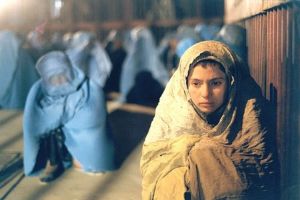
Women’s equal rights have always been an issue throughout the whole world. I always thought of myself as a respecter of woman but never thought the issue of women’s rights in the Middle East was of great importance. In Islam, it is easy to view Muslim women as oppressed, but I have come to learn that the majority of Muslim women are happy with their lives, wear the hijab, etc. because they want to; but there still are sad and depressing cases of women being oppressed. It was because of this assumption that I realized in CNN’s journalist John Blake’s article about the hijab the following is stated by a young female Muslim, “‘My mom says a girl is like a jewel. When you have something precious, you usually hide it. You want to make sure you keep it safe until that treasure is ready to be found.’” But even with the ability for women to do things happily, some women still feel oppressed. In the movie Osama, we see that under the Taliban reign women are strongly oppressed, there is no sense of freedom or even joy. Osama, a young girl that pretends to be a little boy so she could earn money, and other women were oppressed to wear entire body coverings, not allowed to work to pay for food, captured and imprisoned for protesting for greater rights. After Osama was found out to truly be a girl, we saw the despicable treatment that Taliban had for women who opposed them. One female journalist and women protesters were ordered to be stoned and Osama to marry an old Taliban cleric. Sad to say, the movie did not end happy which I believe was the point director Siddiq Barmak, showing the tragedy of women in Afghanistan and under the Taliban rule. This helped me realized how much I appreciate the United States opposing the Taliban and other similar organizations through military strategy. It opened my eyes to now be more active supporter of women’s rights.

For the movie Stoning of Soraya M. I knew that it was rated R and I have never been an R rated movie-watcher before, but after much discussion in class and the desire to see things for the deeper value in them I decided to watch it because I wanted to become more knowledgeable of the issue of women’s rights, especially after seeing Osama. As you see a community run by men and their ability to be deceived by a man who just wanted something for himself, you begin to gain a quick understanding that this situation is wrong. The deceiving led up to the stoning of Soraya, which the movie showed in graphic detail, and in the end the husband couldn’t marry his new wanted wife so all his lies and deceiving were for nothing. It showed the unrighteous judgments cast upon women in an Islamic state without justice. In Iran; where the movie takes place, Sharia law is enforced, and though stoning was abolished in 2008 (the same year the movie came out) as a form of punishment for adultery, in just the last year there were 34 recorded stonings in Iran. This is only the recorded accounts of stoning; how many more have happened that are not recorded? After I finished the movie I went to my bedroom and wept like a little child. If it had not been for films like this I may never have come to know more of the struggles women go through.

In Palestine you see the continuous tumult and distress over the Israeli occupation in the Palestinian lands. For 60 years Israel has occupied the territory once filled majorly by Palestinians but in 1948 Jews around the world were given a state of their own. Today, there is great contention between Israel and Palestine from peace talks, bull dozing homes, and suicide bombers. Though my overall opinion on this subject has not changed drastically, I feel more confident and solidified of my position and more capable of sharing my opinion than before. Paradise Now is a movie that helps exemplify the struggles two young Palestinian men go through on whether or not they should fulfill their missions as suicide bombers. This movie gave a greater insight as to why Palestinians would even contemplate the idea of blowing up innocent people. You see the thought process behind the characters Said and Khaled, the two chosen to do the deed; both at one point were unsure if they should do it. Suha, a mutual female friend of the two was able to bring in a different option other than blowing themselves up. Suha is a Palestinian but from France and Morocco and I believe this gives her have an outsider viewpoint of the issue between the Israeli’s and Palestinian’s. She makes the claim that blowing each other up will not accomplish anything but more death and anger. Though Said does end up committing the deed, Khaled does not and I believe this gives the idea that it is possible to get around the anger and hatred around this conflict. The director of the movie, Abu-Assad, makes this true statement; "The film is an artistic point of view of that political issue. The politicians want to see it as black and white, good and evil, and art wants to see it as a human thing." I believe in this statement and Paradise Now exemplifies the inhumanity of this conflict. I believe the more this conflict is made aware by various forms, one of such is film; the world will begin to help this conflict and see that greater humanity is needed from both sides.

          Lastly, I have learned a great deal about family morals in the Islamic culture through the films we viewed in the class. Islamic family values are very similar to the Latter-day Saint perspective. In The Color of Paradise I saw a view I had not seen in any other Middle Eastern movie which showed the grandmother or “granny” having a great measure of love shown to the grandchildren. Usually, most women, if not being oppressed are busy bossing other people around; this is what I have seen in my own experience with Muslim women. It changed my opinion of that poor stereotype and I became open to the idea of women to being more caring. The film follows the experiences of a young blind boy who is in tune with his feelings and feelings of others, particularly his father the has to learn to appreciate his son for who he is. For the father to learn to love his blind son was what seemed to fit something my friend from Jordan already learned that taught me a lifelong lesson. I recall a time when my friend Mohammad from Jordan was here at BYU studying law, he brought his wife and two young children. He did not know much of how to get around, so he wanted to buy a car. I offered to help him find one and during this time I learned a great lesson that reminded me of my own father and the Latter-day Saint family values. One night after seeing a few cars to buy I mentioned that there were some good options, but he was not happy with them and said, “The car must be able to protect my family and be sturdy. I do not want to put my wife and children in any harm’s way.” It was at that moment that I realized what he said was true and Muslims cared about their families just as much as any good Latter-day Saint family does. I think most people in the United States do not comprehend the idea that people in the Middle East they are loving and kind towards their family.


Film has always been a big part of my learning process and though these films are not all true and maybe a little dramatized like most Western films I learned a great amount about the importance of women rights in the Middle East, the Israeli and Palestinian conflict and the values of the family in Islamic culture. Each of these, though different topics, are connected because they help create a greater understanding for social issues in the Middle East. Most of us Westerners do not comprehend all of the hardships that take place there, and maybe not all will ever be able to because it is a different world, way of thinking, traditional practices, full of different religions that seem conflicting to our own but this does not mean we cannot try and desire for a better world where understanding of each other’s differences and similarities can solve the issues of this world.