What difference can I make? What difference can you make? Well, I guess that all begins with what and why you are trying to make a difference in. For me I am constantly thinking of what I can do for the Middle East and trying to make a difference sure seems impossible. Sometimes it is so incredibly frustrating that I think why do I even think I can do anything. But then I had my first day of class in Political Science of the Middle East class with Professor Donna Lee Bowen. She started off in her dignified way that she does, probably 5' 2'' in mid 50's and striking confidence, saying,
"Today in the Middle East there is great turmoil all over the place. And after 9/11 I thought what can I do to help my students and the people of the Middle East? I realized there was nothing I could do more than pray. So I'd like to start class with prayer and do the thing I know that works."
It hit right then that I may be just one individual but I pray for that peace. Professor Bowen prayed for our enemies, our loved ones, for understanding of each other, for peace, for protection, and for our service men and women. The next class session, she asked me to pray and then asked me to make sure I included the servicemen and women in the Middle East and their families.
Here is a extremely well educated woman in the politics of the Middle East and she says the only thing she can really do to help solve the problems in the Middle East is through prayer struck me hard. She spoke of peace being possible over there. She spoke of the great calamities that can be overcome and I took from that class period that I have forgotten the possibility through faith and prayer.
I had a dream the other night I was Lawrence of Arabia, a British soldier that helped gained unity with the Arab tribes to help form tribes. He did a great work to help the current problems at the time. But I don't know if I will ever be in situation to help them like he did. So why not pray when you want to make a difference in this world?
Sunday, January 9, 2011


Thursday, December 23, 2010
The Spirit of Christmas is the Spirit of the Atonement
I don't want to say the typical things you hear of how we are missing the real meaning of Christmas. I'd rather share what the meaning of Christmas is to me with a personal insight.

I have fond memories as a little boy of my whole family sitting together in my grandparent's home and usually scriptures from Luke chapter two from the New Testament being shared of shepherds, wise men, angels, a star, and the miraculous birth of Jesus through the virgin Mary. I do remember having a sense of awe but mostly couldn't wait to open my Christmas Eve present and play with my brothers and cousins that were there. It wasn't until I was probably about ten that I felt I comprehended why Christmas was a sacred time through it's celebration of the birth of Christ.
We had just moved into our new home (the one my family currently lives in) and it was Easter day. We have some apricot trees in our new backyard that in the spring time grow flowers before the apricots begin to grow. Maybe some of you recall the song "Popcorn Popping," well the song is true, it really looks like popcorn! I saw this and remembered how vastly plain the trees had looked during the winter and now it was beginning anew, a rebirth, a newness, a fresh start. I then remembered what Easter was about - the resurrection of Jesus Christ. Then it hit me, "Christmas isn't about the birth of a baby through a miraculous event, it is about the birth of our Savior to perform the Atonement so that all of us may return to live with our Heavenly Father. Christmas isn't just about a miraculous birth but about what came about through the birth of Him who is most important for each of us.
This months First Presidency message is by President Uchtdorf he invites us to find a way to remember Christ more this season. When I taught this while home teaching most of them said through acts of service, reading the scriptures and remembering the Savior more often, etc. are how we can remember Christ more. I thought about those a lot and thought I'd see what I have done that has brought me closer to Christ this season.
There was one simple moment of a friend and I walking back from sledding - she suggested we sing Christmas carols, so we did. While singing, even missing words here and there, we could feel the love that God has for us. I remember occasionally turning to look at her while singing and there were big smiles on our faces because of what it meant to sing these songs with deeper meanings than we can comprehend.
President Uchtdorf in his message says the following:
"The Christmas season is wonderful in many ways. It is a season of charitable acts of kindness and brotherly love. It is a season of being more reflective about our own lives and about the many blessings that are ours. It is a season of forgiving and being forgiven. It is a season to enjoy the music and lights, parties and presents. But the glitter of the season should never dim our sight and prevent us from truly seeing the Prince of Peace in His majesty."
Being more reflective of what the Savior has done, being forgiving and forgiven, coming closer to Christ - do these not all pertain what the Atonement does for us? I believe it does.
We have gifts we give to family and friends and what of a gift to Christ? This Christmas my gift to my Savior is to walk a little closer to Him, stand a little taller, do better in all that I do. I want to give my will to Him. I guess you can think of it as a renewal, a rebirth, gaining a brighter hope, a lot like the apricot tree in my backyard but for me in my life; all because of the birth of our Savior and the atonement. This season is a time to think of what the atonement has done for us and in turn give Christ's infinite love towards others.
"There is no better time than now, this very Christmas Season, for all of us to rededicate ourselves to the principles taught by Jesus Christ" - President Thomas S. Monson
I pray each day that I may stand as a witness to the divinity of Christ's eternal love. Merry Christmas to all of you!
Friday, December 3, 2010
A Brief Middle East Movie Review
After watching the designated films in my Humanities of Islam class my eyes and mind have been opened to not only to foreign film but also to issues that never seemed of great importance. Throughout the semester I have been anticipating the films to watch for the class; I guess you can say I love a good movie with a strong message and these films have been exactly that. Osama, Leila, Paradise Now, Color of Paradise and the rest have been great influences; they inspired me to watch a movie that was not assigned of which was called Stoning of Soraya M. (2008) which depicts the dramatic true story of a wife being falsely accused of adultery by her husband just so he could take a younger wife that leads to her death by stoning. Soraya’s story left me in complete shock with a greater desire to do something about this treachery. Soraya’s story on film and many others have played a huge impact on individuals and me to change my view from of little importance and knowledge to an impactful understanding to not only want to learn more but do more. Using the films listed above I would like to share how my feelings and impressions have changed with the following issues: women’s rights in Islamic states, Palestinian/Israeli conflict and family values in Islamic culture.
Women’s equal rights have always been an issue throughout the whole world. I always thought of myself as a respecter of woman but never thought the issue of women’s rights in the Middle East was of great importance. In Islam, it is easy to view Muslim women as oppressed, but I have come to learn that the majority of Muslim women are happy with their lives, wear the hijab, etc. because they want to; but there still are sad and depressing cases of women being oppressed. It was because of this assumption that I realized in CNN’s journalist John Blake’s article about the hijab the following is stated by a young female Muslim, “‘My mom says a girl is like a jewel. When you have something precious, you usually hide it. You want to make sure you keep it safe until that treasure is ready to be found.’” But even with the ability for women to do things happily, some women still feel oppressed. In the movie Osama, we see that under the Taliban reign women are strongly oppressed, there is no sense of freedom or even joy. Osama, a young girl that pretends to be a little boy so she could earn money, and other women were oppressed to wear entire body coverings, not allowed to work to pay for food, captured and imprisoned for protesting for greater rights. After Osama was found out to truly be a girl, we saw the despicable treatment that Taliban had for women who opposed them. One female journalist and women protesters were ordered to be stoned and Osama to marry an old Taliban cleric. Sad to say, the movie did not end happy which I believe was the point director Siddiq Barmak, showing the tragedy of women in Afghanistan and under the Taliban rule. This helped me realized how much I appreciate the United States opposing the Taliban and other similar organizations through military strategy. It opened my eyes to now be more active supporter of women’s rights.
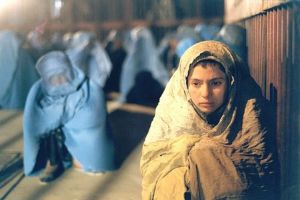
For the movie Stoning of Soraya M. I knew that it was rated R and I have never been an R rated movie-watcher before, but after much discussion in class and the desire to see things for the deeper value in them I decided to watch it because I wanted to become more knowledgeable of the issue of women’s rights, especially after seeing Osama. As you see a community run by men and their ability to be deceived by a man who just wanted something for himself, you begin to gain a quick understanding that this situation is wrong. The deceiving led up to the stoning of Soraya, which the movie showed in graphic detail, and in the end the husband couldn’t marry his new wanted wife so all his lies and deceiving were for nothing. It showed the unrighteous judgments cast upon women in an Islamic state without justice. In Iran; where the movie takes place, Sharia law is enforced, and though stoning was abolished in 2008 (the same year the movie came out) as a form of punishment for adultery, in just the last year there were 34 recorded stonings in Iran. This is only the recorded accounts of stoning; how many more have happened that are not recorded? After I finished the movie I went to my bedroom and wept like a little child. If it had not been for films like this I may never have come to know more of the struggles women go through.

In Palestine you see the continuous tumult and distress over the Israeli occupation in the Palestinian lands. For 60 years Israel has occupied the territory once filled majorly by Palestinians but in 1948 Jews around the world were given a state of their own. Today, there is great contention between Israel and Palestine from peace talks, bull dozing homes, and suicide bombers. Though my overall opinion on this subject has not changed drastically, I feel more confident and solidified of my position and more capable of sharing my opinion than before. Paradise Now is a movie that helps exemplify the struggles two young Palestinian men go through on whether or not they should fulfill their missions as suicide bombers. This movie gave a greater insight as to why Palestinians would even contemplate the idea of blowing up innocent people. You see the thought process behind the characters Said and Khaled, the two chosen to do the deed; both at one point were unsure if they should do it. Suha, a mutual female friend of the two was able to bring in a different option other than blowing themselves up. Suha is a Palestinian but from France and Morocco and I believe this gives her have an outsider viewpoint of the issue between the Israeli’s and Palestinian’s. She makes the claim that blowing each other up will not accomplish anything but more death and anger. Though Said does end up committing the deed, Khaled does not and I believe this gives the idea that it is possible to get around the anger and hatred around this conflict. The director of the movie, Abu-Assad, makes this true statement; "The film is an artistic point of view of that political issue. The politicians want to see it as black and white, good and evil, and art wants to see it as a human thing." I believe in this statement and Paradise Now exemplifies the inhumanity of this conflict. I believe the more this conflict is made aware by various forms, one of such is film; the world will begin to help this conflict and see that greater humanity is needed from both sides.

Lastly, I have learned a great deal about family morals in the Islamic culture through the films we viewed in the class. Islamic family values are very similar to the Latter-day Saint perspective. In The Color of Paradise I saw a view I had not seen in any other Middle Eastern movie which showed the grandmother or “granny” having a great measure of love shown to the grandchildren. Usually, most women, if not being oppressed are busy bossing other people around; this is what I have seen in my own experience with Muslim women. It changed my opinion of that poor stereotype and I became open to the idea of women to being more caring. The film follows the experiences of a young blind boy who is in tune with his feelings and feelings of others, particularly his father the has to learn to appreciate his son for who he is. For the father to learn to love his blind son was what seemed to fit something my friend from Jordan already learned that taught me a lifelong lesson. I recall a time when my friend Mohammad from Jordan was here at BYU studying law, he brought his wife and two young children. He did not know much of how to get around, so he wanted to buy a car. I offered to help him find one and during this time I learned a great lesson that reminded me of my own father and the Latter-day Saint family values. One night after seeing a few cars to buy I mentioned that there were some good options, but he was not happy with them and said, “The car must be able to protect my family and be sturdy. I do not want to put my wife and children in any harm’s way.” It was at that moment that I realized what he said was true and Muslims cared about their families just as much as any good Latter-day Saint family does. I think most people in the United States do not comprehend the idea that people in the Middle East they are loving and kind towards their family.

Film has always been a big part of my learning process and though these films are not all true and maybe a little dramatized like most Western films I learned a great amount about the importance of women rights in the Middle East, the Israeli and Palestinian conflict and the values of the family in Islamic culture. Each of these, though different topics, are connected because they help create a greater understanding for social issues in the Middle East. Most of us Westerners do not comprehend all of the hardships that take place there, and maybe not all will ever be able to because it is a different world, way of thinking, traditional practices, full of different religions that seem conflicting to our own but this does not mean we cannot try and desire for a better world where understanding of each other’s differences and similarities can solve the issues of this world.
Sunday, November 14, 2010
The Name of God
After going to a friends church a few times, I noticed one thing that was done differently than in my own (besides the fact there was a rock band and the entire church service was only 20 minutes long) and it was the prayers. They were heartfelt and sincere but they missed the teaching of praying in His name, Jesus Christ.

We are commanded to pray in the name of Christ as Christians.
And I pray the Father in the name of Christ that many of us, if not all, may be saved in his kingdom at that great and last day.
But behold, I say unto you that ye must pray always, and not faint; that ye must not perform any thing unto the Lord save in the first place ye shall pray unto the Father in the name of Christ, that he will consecrate thy performance unto thee, that thy performance may be for the welfare of thy soul.
Tonight, I watched two of the hardest movies I have ever watched before. Both showed the extremes of two religions, Judaism and Islam, being in great persecution by their own or by others. In one, while one was being stoned, the many false accusers yelled out, "Allahu Akbar" which means "The Most Great God." Allahu Akbar is a Qur'anic statement often said in prayers and recitations throughout Islam. Bismillah is another common term. Both show the great respect of God's name. In Judaism and Christianity, we have names Jehovah and Elohim. In LDS doctrine we believe Jehovah to be Jesus Christ and Elohim to Heavenly Father or even Jesus Christ's father. As I heard these men yell that phrase my heart broke knowing that they thought what they were doing was in the name of God which in fact the name of God was taken in vain. The woman was stoned to death because of false accusations due to her husband simply wanting another wife. The religious leaders who were corrupt to begin with allowed this false accusation to take control of the city hidden far away in the mountains of Iran. There was no earthly righteous justice to come to this woman. But there was God's justice. Even though, this wicked and wrong-minded men used "Allahu Akbar," "Allah is the greatest," a true statement of righteous heavenly judgement for this woman for surely Allah (God) will give her exactly that.
I wonder what it means to God when we call upon him. I gave a blessing last week to a sister in my ward in which the blessing I spoke of her ability to know that her Heavenly Father loves her, to which I said her "daddy" loved her. Even our perfect example Jesus Christ used this as He was upon the cross:
And he said, Abba, Father, all things are possible unto thee; take away this cup from me: nevertheless not what I will, but what thou wilt.
Abba referring to a Hebrew or Aramaic word most commonly translated to "daddy." Jesus Christ understood His relationship with His Father. Do we? We will not understand it as Christ did in this life time, but are we growing closer to our Father in heaven? Do we pray each morning and night? When was the last time you had a sincere prayer? After these two movies (which I viewed one after another) I went to my room and weeped as a little child because of the great hold Satan has upon this world.
It is almost surreal to realize, growing up in this time of the world and living in the United States, living in a country of freedom of religion, equality is greater here than anywhere else. Do I fully comprehend my relationship with God? Have I been so blessed and ungrateful for it to become blind to my relationship with God? I was born in the Latter-day Saint faith and consider that a miracle to which I do not understand why me but I often try my best to see the world through God's other children's view and understand the true meaning of God's eternal plan for each of us. I am only beginning this long journey and pray I may continue to be led by His Holy Spirit.
I am grateful for my God and His tender mercies. I am grateful for prayer and how it allows me to speak to Him anytime I want. I am grateful to know the plan of happiness and to have that eternal perspective. I am grateful for my loving family and the amazing joy I receive from them. I am grateful to be spiritually led to study Arabic and the Middle East. This decision in my life is not understood by most but the inspiration came from Father himself. I am grateful for my membership in the church, of which I understand more and more what it really means.
Allah, Elohim, Jehovah, El Shaddai, Adonai, Jesus Christ, Prince of Peace, God, Heavenly Father, Daddy, is all the same to me.

Tuesday, November 9, 2010
Stay In The Light
Stay in the light. Yes, that's what I said. Last Saturday night I went to the Provo Temple and as I was sitting in a sealing room I noticed the beautiful wall paper that was there. The design was of floral design - vegetal plants interwoven within each other, but then I noticed that where the light from the lamps on the way were not showing you could not see the floral design. The rays of light showed the beautiful attribute of the wall while where the light did not shine directly on the wall paper you could only see the whiteness of the wall with no design. This thought came to me as a parallel of what it means to be in the light: The light is the gospel of Jesus Christ, keeping the commandments, and following the prophet.


In life we have our times of happiness and joy. No matter how hard we try to do everything right, things still go wrong. It is then evident why it is important to be in the "light" or the teachings of our Savior Jesus Christ; namely through his servants, the prophets. Jesus Christ has always used messengers or special witnesses to share His teachings so that we may have a guide or a map to lead us back to our Heavenly Father. Noah, Abraham, Moses, Isaiah, Peter, John, etc. are some examples of God's prophets. Today we have a living prophet. Currently this is Thomas S. Monson and he follows the examples of the prophets before him.
Preach My Gospel describes the role of a prophet well:
"Truth is a knowledge of things as they really are, were, and will be. It does not change with conditions or time. Truth is the same in every age and culture. God is the source of all truth. We can have faith in Him because we know He will teach us only truth. God wants all His children to know the truth. Therefore, He reveals the truths necessary for salvation through prophets and apostles. He reveals truth to us personally through the scriptures and personal revelation.
A prophet is called and chosen by God and is a righteous man with great faith. The Lord reveals truth to him through the Holy Ghost. He commands His prophet to teach truth to all people. Those who believe God’s words as revealed through His prophet are blessed. Christ’s Church is built on the foundation of apostles and prophets, who direct the Church by revelation. The Lord called Joseph Smith as the first prophet and head of this last dispensation. His successors who lead The Church of Jesus Christ of Latter-day Saints today are also prophets and apostles. The President of the Church today is a living prophet. We are to have faith in God’s chosen prophet, gain conviction of his divine calling, and follow his teachings.
We have frequent opportunities to sustain Church leaders publicly. Sustain means to support. We are to prepare ourselves so that when the prophets and apostles speak, the Holy Ghost can confirm the truths they teach, and we can then determine to follow the counsel they give us.
Those who listen to and follow the counsel of living prophets and apostles will not go astray. The teachings of living prophets provide an anchor of eternal truth in a world of shifting values and help us avoid misery and sorrow. The confusion and strife of the world will not overwhelm us, and we can enjoy the assurance of being in harmony with God’s will."
It is my testimony that no matter how hard life may be - if we feel lonely, sad, lost or distraught - that if we heed the teachings of a true prophet of God we will be able to conquer the adversary even when he sends his best against us. It is important to know that when we follow the prophet we have the promise of the Lord's strength on our side and we can live after the manner of happiness. May we all live in the light of our Savior.
Subscribe to:
Posts (Atom)